

Introduction: The Hidden Bottleneck Behind High-Speed Edge Banding Production
As panel furniture manufacturing continues to move toward automation and intelligent production, many factories have invested heavily in CNC cutting centers, automatic feeding systems, and high-speed double-edge banding lines. However, despite these upgrades, some manufacturers still experience unexpected production interruptions, unstable output, and increasing labor costs.
The root cause is often not the edge banding machine itself.
Instead, the real bottleneck lies in manual unloading operations.
Many furniture manufacturers focus on improving processing speed but overlook the importance of material flow after edge banding. When finished panels cannot be removed quickly and consistently, the entire production line is forced to slow down or stop completely.
At Fortran Machinery, we have helped numerous furniture factories solve this challenge through intelligent unloading and conveying solutions. This article explores why manual unloading creates frequent downtime and how automated unloading systems can transform production efficiency.
What Is an Automatic Unloading System for Double-Edge Banding Lines?
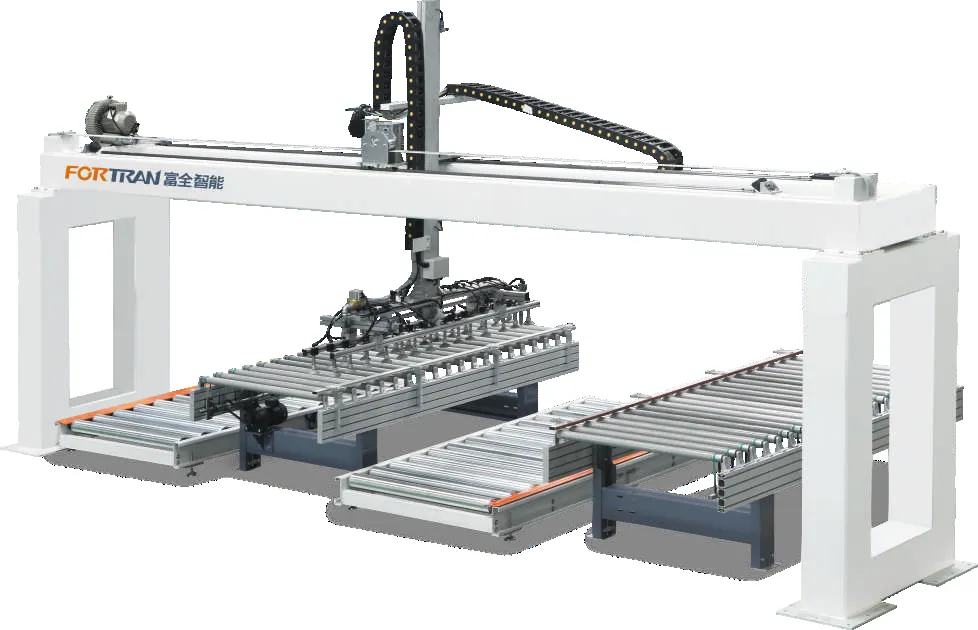
An automatic unloading system is an intelligent conveying and handling solution designed to receive finished panels directly from a double-edge banding machine and transfer them to the next production process without manual intervention.
Unlike traditional manual unloading methods, automated systems maintain continuous production flow while reducing labor dependency.
A complete unloading solution typically includes:
Automatic receiving conveyor
Intelligent transfer conveyor
Sorting and buffering system
Return conveyor system
Lifting or stacking modules
PLC intelligent control system
When integrated into a double-edge banding line, the system creates a seamless material flow that supports high-speed production and minimizes downtime.
Why Manual Unloading Causes Frequent Downtime
1. Human Speed Cannot Match Machine Speed
Modern double-edge banding machines can process panels at speeds of 20–30 meters per minute.
A skilled operator may successfully unload several panels, but continuous production quickly creates pressure.
When production speed exceeds unloading capacity:
Panels begin accumulating at the machine exit.
Material congestion occurs.
Emergency stops become more frequent.
Production efficiency declines.
Industry data shows that manual unloading can reduce overall edge banding line efficiency by 15%–30%.
2. Operator Fatigue Leads to Production Interruptions
Furniture factories often operate 8–12 hours per shift.
Repeated lifting, carrying, and stacking of panels places significant physical demands on workers.
After several hours of continuous operation:
Handling speed decreases.
Errors increase.
Workplace accidents become more likely.
Machine waiting time rises.
Studies indicate that worker productivity may decrease by 10%–20% during extended repetitive handling tasks.
3. Labor Shortages Increase Production Risks
The furniture industry is facing growing labor challenges worldwide.
Manufacturers frequently report:
Difficulty recruiting skilled operators.
High employee turnover.
Rising labor costs.
Inconsistent workforce availability.
A production line dependent on manual unloading becomes vulnerable whenever staffing levels change.
One absent operator can directly impact production output.
4. Product Damage Increases During Manual Handling
Finished panels often have freshly applied edge bands that require careful handling.
Manual unloading increases the risk of:
Corner damage
Surface scratches
Edge impact defects
Product contamination
Even a small defect rate can significantly affect profitability.
For example:
| Production Volume | Damage Rate | Daily Defective Panels |
|---|---|---|
| 1,000 Panels | 3% | 30 Panels |
| 2,000 Panels | 3% | 60 Panels |
| 3,000 Panels | 3% | 90 Panels |
Automated unloading systems can reduce handling-related damage by more than 70%.
Application Scenarios
As furniture manufacturers continue to pursue higher productivity, lower labor costs, and greater production flexibility, automatic unloading systems have become an essential component of modern production lines. While many people associate unloading systems only with material transfer, their real value lies in optimizing workflow, reducing bottlenecks, and improving the overall efficiency of the factory.
The Fortran Machinery Automatic Unloading System is designed to support multiple production environments and can be customized according to different product types, factory layouts, and production capacities.
Below are the most common application scenarios and the measurable benefits customers can achieve.
1. Large-Scale Panel Furniture Manufacturing
Large panel furniture factories often produce:
Kitchen cabinets
Wardrobes
Office furniture
Bathroom cabinets
Storage systems
Customized home furniture
These manufacturers typically operate high-speed double-edge banding lines with daily outputs ranging from 1,000 to 5,000 panels.
In traditional production environments, operators struggle to keep up with machine output, resulting in frequent congestion at the unloading section.
The Fortran Machinery Automatic Unloading System automatically transfers finished panels to subsequent processes, ensuring uninterrupted production.
Performance Improvements
| Indicator | Manual Unloading | Automatic Unloading |
|---|---|---|
| Daily Panel Output | 2,000 Panels | 2,600-3,000 Panels |
| Line Utilization Rate | 70%-75% | 90%-95% |
| Labor Requirement | 4-6 Workers | 1-2 Workers |
| Material Waiting Time | 15%-20% | Less than 5% |
Many large furniture factories report overall production capacity increases of 25%-40% after implementing automated unloading systems.
2. Intelligent Furniture Production Lines
Modern smart factories require all production equipment to operate as an integrated system rather than isolated machines.
A typical intelligent production line includes:
CNC cutting center
Automatic labeling machine
Edge banding machine
Drilling machine
Sorting system
Packaging line
In these environments, manual unloading often becomes the weakest link.
The Fortran Machinery Automatic Unloading System connects seamlessly with intelligent manufacturing equipment and helps create continuous production flow.
Smart Factory Benefits
| Indicator | Traditional Production | Intelligent Production |
|---|---|---|
| Automation Level | 60%-70% | 90%-95% |
| Production Visibility | Limited | Real-Time Monitoring |
| Material Tracking | Manual | Automated |
| Data Collection | Partial | Full Process Data |
Industry studies indicate that intelligent factories with automated material handling systems can improve Overall Equipment Effectiveness (OEE) by 15%-30%.
3. High-Speed Double-Edge Banding Workshops
High-speed double-edge banding machines are becoming increasingly popular due to their ability to process both sides of a panel simultaneously.
However, these machines create significant unloading challenges.
A modern double-edge banding line can process:
15-25 panels per minute
900-1,500 panels per hour
More than 10,000 panels per day
Manual operators simply cannot maintain this pace consistently throughout a full production shift.
The result is:
Material accumulation
Emergency machine stops
Reduced productivity
The automatic unloading solution from Fortran Machinery ensures finished panels are transferred immediately, maintaining stable production speed.
Typical Production Comparison
| Item | Manual Operation | Automatic Operation |
|---|---|---|
| Machine Downtime | Frequent | Reduced by 40%-60% |
| Material Congestion | High | Minimal |
| Operator Fatigue | Significant | Very Low |
| Production Stability | Variable | Consistent |
Many customers report a 20%-35% increase in actual production output after replacing manual unloading with automated systems.
4. Customized Furniture Manufacturing
Customized furniture production has become one of the fastest-growing sectors in the industry.
Unlike mass production, custom manufacturing involves:
Small batch orders
Frequent size changes
Diverse panel specifications
Complex production scheduling
These characteristics create additional challenges for manual unloading.
The Fortran Machinery Automatic Unloading System automatically adapts to varying panel sizes and production requirements without requiring extensive operator intervention.
Flexible Manufacturing Benefits
| Indicator | Traditional Method | Automated Method |
|---|---|---|
| Product Changeover Time | High | Reduced |
| Panel Size Compatibility | Limited | Wide Range |
| Operator Adjustment Frequency | Frequent | Minimal |
| Production Flexibility | Moderate | Excellent |
Factories producing customized furniture often achieve 15%-25% shorter production cycles after automation upgrades.
5. Labor-Shortage Manufacturing Environments
One of the biggest challenges facing furniture manufacturers worldwide is labor availability.
Many factories experience:
Difficulty hiring workers
Rising wages
High employee turnover
Aging workforce
In some regions, labor costs increase by 8%-15% annually.
The automatic unloading system significantly reduces dependence on manual labor.
Workforce Optimization Results
| Workforce Metric | Before Automation | After Automation |
|---|---|---|
| Unloading Operators | 4-5 Workers | 1 Worker |
| Labor Cost | 100% Baseline | Reduced by 60%-80% |
| Training Requirements | High | Low |
| Production Impact from Staff Absence | Significant | Minimal |
This makes automation a strategic investment rather than simply an operational upgrade.
6. Export-Oriented Furniture Factories
Furniture manufacturers serving international markets often face strict delivery schedules and quality standards.
Major export markets require:
Consistent product quality
Stable production capacity
Fast lead times
Reduced damage rates
The Fortran Machinery Automatic Unloading System helps exporters improve production consistency and reduce handling-related defects.
Export Manufacturing Benefits
| Indicator | Manual Handling | Automated Handling |
|---|---|---|
| Product Damage Rate | 2%-5% | Less than 1% |
| Order Delivery Stability | Moderate | Excellent |
| Production Consistency | Variable | High |
| Customer Complaint Rate | Higher | Significantly Lower |
Some export manufacturers have reported 70%-90% reductions in transportation-related panel damage after implementing automated unloading solutions.
7. Future Industry 4.0 Factories
Industry 4.0 is transforming furniture manufacturing through:
Smart equipment
Real-time data analysis
Digital production management
Predictive maintenance
Automatic unloading systems act as a critical bridge between production equipment and digital factory platforms.
The Fortran Machinery Automatic Unloading System supports integration with:
MES systems
ERP platforms
WMS systems
Robotics
IoT monitoring solutions
Industry 4.0 Readiness
| Capability | Traditional Factory | Smart Factory |
|---|---|---|
| Equipment Connectivity | Limited | Full Integration |
| Production Analytics | Basic | Advanced |
| Predictive Maintenance | Not Available | Available |
| Real-Time Monitoring | Partial | Complete |
Manufacturers adopting Industry 4.0-ready automation solutions often gain a significant competitive advantage in future market development.
Real-World Value Across Multiple Applications
Regardless of production scale or product type, the application value of the Fortran Machinery Automatic Unloading System remains consistent:
Increase production capacity by 20%-40%
Reduce labor requirements by 60%-80%
Improve line utilization to 90%-95%
Reduce panel damage by 70%-90%
Decrease machine downtime by 40%-60%
Achieve ROI within 12-18 months
Whether serving large furniture factories, customized furniture workshops, export-oriented manufacturers, or future smart factories, the automatic unloading system provides a reliable pathway toward higher efficiency, lower costs, and sustainable growth.
For manufacturers seeking long-term competitiveness, automation is no longer an option—it is becoming a necessity. Fortran Machinery helps customers transform these challenges into measurable business opportunities through intelligent unloading solutions tailored to real production needs.
Technical Parameters of Fortran Machinery Automatic Unloading Solutions
At Fortran Machinery, our unloading systems are designed specifically for modern furniture manufacturing environments.
Typical Technical Specifications
| Item | Specification |
|---|---|
| Applicable Panel Length | 300–3000 mm |
| Applicable Panel Width | 200–1200 mm |
| Panel Thickness | 8–60 mm |
| Conveyor Speed | 15–40 m/min |
| Load Capacity | Up to 150 kg |
| Control System | PLC + Touch Screen |
| Positioning Accuracy | ±1 mm |
| Power Supply | 380V / 50Hz |
| Communication Interface | Ethernet / Modbus |
| Equipment Availability | ≥98% |
| Noise Level | ≤70 dB |
Key Advantages of Fortran Machinery Unloading Systems
For many furniture manufacturers, investing in an automatic unloading system is not simply about replacing labor. The real goal is to eliminate production bottlenecks, improve line utilization, reduce operational risks, and create a scalable manufacturing system capable of supporting future growth.
At Fortran Machinery, our unloading systems are designed based on real production challenges encountered in panel furniture factories. By integrating intelligent control, high-speed conveying, and customized engineering solutions, we help customers achieve measurable improvements across multiple performance indicators.
1. Significant Labor Cost Reduction
Labor costs continue to rise globally, while finding experienced operators becomes increasingly difficult.
In traditional double-edge banding production lines, manufacturers often require multiple workers to perform unloading, sorting, stacking, and transportation tasks.
After implementing a Fortran Machinery Automatic Unloading System, many customers achieve substantial labor savings.
Typical Labor Comparison
| Item | Manual Unloading | Automatic Unloading |
|---|---|---|
| Operators Required | 3-5 Workers | 1 Worker |
| Labor Reduction | — | 60%-80% |
| Daily Handling Hours | 8-12 Hours | Minimal Manual Intervention |
| Recruitment Pressure | High | Significantly Reduced |
For a medium-sized furniture factory operating two shifts, reducing just 3 operators can save approximately $18,000-$35,000 annually, depending on local labor costs.
2. Higher Production Efficiency and Line Utilization
One of the biggest hidden costs in furniture manufacturing is machine idle time.
Even the fastest double-edge banding machine cannot achieve maximum output if finished panels are not removed quickly enough.
Manual unloading often creates:
Material accumulation
Conveyor congestion
Emergency stops
Production interruptions
The intelligent unloading system from Fortran Machinery synchronizes automatically with machine output speed.
Efficiency Improvement Data
| Performance Indicator | Before Automation | After Automation |
|---|---|---|
| Line Utilization Rate | 65%-75% | 90%-95% |
| Material Waiting Time | 15%-20% | Less than 5% |
| Machine Downtime | Frequent | Reduced by 40%-60% |
| Overall Throughput | Baseline | Increased by 20%-35% |
For factories processing 1,500 panels per day, a 25% efficiency increase can translate into hundreds of additional panels produced daily without adding labor.
3. Improved Product Quality and Reduced Damage
Finished panels exiting edge banding machines are particularly vulnerable to handling damage.
Manual unloading can lead to:
Corner chipping
Surface scratches
Edge impact marks
Stacking deformation
These defects not only increase rework costs but also affect customer satisfaction.
The automated unloading solution from Fortran Machinery uses controlled conveying and positioning technology to minimize unnecessary contact.
Quality Improvement Results
| Quality Indicator | Manual Handling | Automatic Handling |
|---|---|---|
| Surface Damage Rate | 2%-5% | Below 1% |
| Corner Damage Incidents | Common | Rare |
| Rework Requirements | High | Significantly Reduced |
| Product Consistency | Variable | Stable |
Many customers report a 70%-90% reduction in transportation-related defects after automation upgrades.
4. Intelligent Production Rhythm Control
Furniture manufacturing relies heavily on balanced production flow.
When unloading speed cannot match machine output, production bottlenecks quickly appear.
Fortran Machinery unloading systems incorporate:
PLC intelligent control
Automatic speed synchronization
Buffering functions
Intelligent flow management
This ensures every workstation operates at an optimized pace.
Production Rhythm Improvements
Up to 30% smoother material flow
Reduced bottleneck formation
Improved workstation coordination
Stable production scheduling
Balanced production flow directly improves overall factory output and delivery performance.
5. Lower Dependence on Skilled Workers
Many furniture manufacturers struggle with:
Skilled labor shortages
High turnover rates
Training costs
Workforce instability
Automation significantly reduces these challenges.
Instead of requiring experienced operators to continuously handle panels, the system performs unloading automatically.
Workforce Benefits
| Human Resource Factor | Traditional Method | Automated Method |
|---|---|---|
| Training Time | 2-4 Weeks | 1-3 Days |
| Labor Dependency | High | Low |
| Operator Fatigue | Significant | Minimal |
| Staff Turnover Impact | Severe | Limited |
Factories can maintain stable production even during labor shortages.
6. Enhanced Workplace Safety
Manual unloading involves repetitive lifting, carrying, turning, and stacking of heavy panels.
This increases the risk of:
Back injuries
Muscle strain
Accidental panel drops
Workplace accidents
According to industrial safety reports, material handling accounts for a significant percentage of manufacturing workplace injuries.
The automated unloading system dramatically reduces physical handling requirements.
Safety Improvements
| Safety Metric | Before Automation | After Automation |
|---|---|---|
| Manual Lifting Frequency | High | Reduced by 80%-90% |
| Worker Fatigue Risk | High | Low |
| Handling-Related Incidents | Frequent | Rare |
| Workplace Safety Rating | Standard | Improved |
A safer workplace also helps reduce insurance and compensation costs.
7. Seamless Integration with Smart Factory Systems
Modern furniture manufacturing is moving rapidly toward digitalization and Industry 4.0.
The unloading systems developed by Fortran Machinery are designed for future expansion and can integrate with:
Double-edge banding machines
CNC drilling centers
Robotic stacking systems
Automatic sorting systems
Packaging lines
MES systems
ERP management platforms
Smart Factory Benefits
Real-time production monitoring
Improved production traceability
Data-driven decision making
Better production scheduling
Increased factory transparency
Factories implementing integrated automation systems often improve Overall Equipment Effectiveness (OEE) by 15%-30%.
8. Faster Return on Investment (ROI)
Ultimately, automation must deliver financial value.
Most customers evaluate investment success based on:
Labor savings
Productivity gains
Reduced defects
Lower operational costs
Typical ROI Calculation Example
| Item | Annual Savings |
|---|---|
| Labor Cost Reduction | $25,000 |
| Productivity Improvement | $35,000 |
| Reduced Product Damage | $8,000 |
| Reduced Downtime | $12,000 |
| Total Annual Benefit | $80,000 |
For a typical automatic unloading project, many furniture manufacturers achieve a complete investment payback period of 12-18 months.
After the ROI period, the system continues generating cost savings and productivity gains year after year.
Why More Furniture Manufacturers Choose Fortran Machinery
The true value of automation lies not only in equipment performance but in long-term business results.
With years of experience in furniture industry automation, Fortran Machinery combines mechanical engineering expertise, intelligent software development, and customized production line design to help customers achieve:
✅ 60%-80% labor reduction
✅ 20%-35% production efficiency improvement
✅ 70%-90% reduction in handling damage
✅ 40%-60% less machine downtime
✅ 90%-95% production line utilization
✅ 12-18 month average ROI
These measurable results are why more and more furniture manufacturers worldwide choose Fortran Machinery as their trusted automation partner.
Common Purchasing Questions
How many operators can be replaced?
Depending on production volume, one automatic unloading system can replace 2–4 unloading workers per shift.
Is it suitable for existing edge banding lines?
Yes.
Fortran Machinery provides customized retrofit solutions compatible with most mainstream double-edge banding machines.
What is the typical ROI period?
Most customers achieve a return on investment within 12–24 months through labor savings and productivity improvements.
Can different panel sizes be processed?
Absolutely.
The system automatically adapts to a wide range of panel dimensions.
Does installation affect production?
Our engineering team develops phased implementation plans to minimize production disruption.
Why Furniture Manufacturers Trust Fortran Machinery
As a technology company integrating mechanical engineering and software development, Fortran Machinery provides far more than standard automation equipment.
Our advantages include:
Customized Engineering Solutions
Every project is designed according to actual workshop layouts and production requirements.
Intelligent Control Technology
Advanced PLC systems ensure stable and reliable operation.
Strong Manufacturing Capacity
Large-scale production capabilities support fast delivery and consistent quality.
Complete Project Support
From design and installation to commissioning and after-sales service, we provide full lifecycle support.
Proven Industry Experience
Our automation solutions are widely applied in furniture manufacturing, helping customers improve efficiency while reducing operating costs.
Many customers report:
20%–40% productivity improvements
30%–50% labor cost reductions
70% lower product damage rates
12–24 month ROI periods
Your Next Step Toward Smarter Furniture Manufacturing
If your double-edge banding line experiences:
✓ Frequent production interruptions
✓ High labor costs
✓ Product handling damage
✓ Unstable production output
✓ Difficulty recruiting operators
It may be time to upgrade your unloading process.
Fortran Machinery offers customized automatic unloading solutions designed specifically for furniture manufacturers seeking higher efficiency and lower operating costs.
Contact Fortran Machinery Today
Our engineering team can provide:
Free production line evaluation
Factory layout optimization
Automation upgrade recommendations
ROI analysis reports
Customized solution proposals
Conclusion
Manual unloading is one of the most overlooked causes of downtime on double-edge banding lines. As production speeds continue to increase, relying on manual handling creates unavoidable bottlenecks that affect efficiency, quality, and profitability.
By implementing an intelligent automatic unloading solution from Fortran Machinery, furniture manufacturers can eliminate production interruptions, reduce labor costs, improve product quality, and build a stronger foundation for future smart factory development.
In modern furniture manufacturing, automation is no longer optional—it is the key to maintaining competitiveness in a rapidly evolving industry. Fortran Machinery is ready to help you take the next step toward a more efficient and intelligent production future.
